
How Often to Actually Change Your Furnace Filter (It's Not What the Box Says)
The real schedule depends on your filter and your house — not the optimistic number on the package.
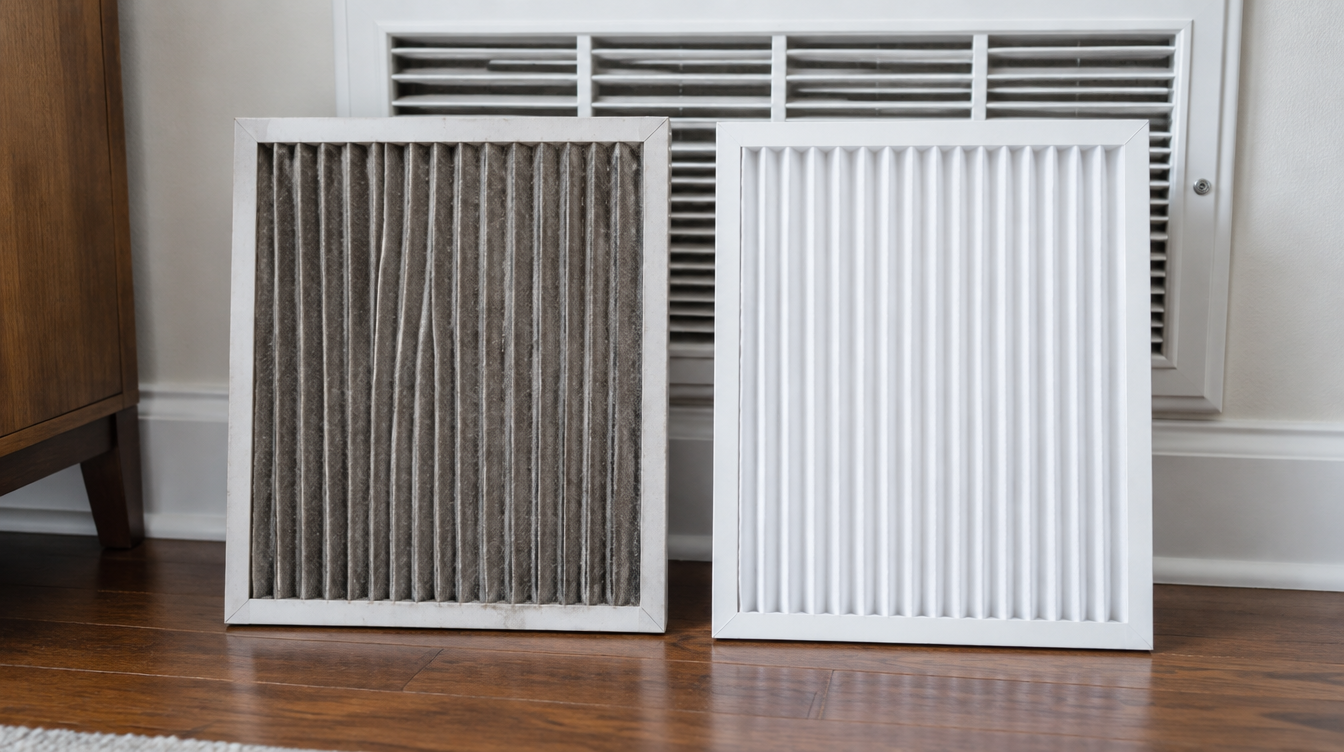
You finally pulled the furnace filter to look at it, held it up to the light, and couldn't see through it. No idea how long it's been in there — a season, maybe two. The box promised "lasts up to 90 days," so what gives, and how often are you actually supposed to swap the thing? It's one of the cheapest, easiest maintenance jobs in the whole house, and also one of the most neglected — usually because nobody ever gave you a straight answer on the schedule.
That "90 days" is a best case printed on a box, not a rule for your house. A filter's real life depends on how thick it is, whether you have pets, and how dusty your home runs. And a choked filter doesn't just dirty your air — it starves the system of airflow, which overworks the blower motor, drives up your energy bill, and is a top cause of a frozen AC coil in summer.
Why a dirty filter is more than a dust problem
The filter's real job isn't so much cleaning your air as protecting the equipment and keeping air moving through it. When it clogs, the blower has to fight to pull air through a wall of trapped dust. That strain does three things: it runs the motor hotter and shortens its life, it makes the system work longer for the same comfort (which you pay for on the bill), and it chokes airflow across the coils. In summer, low airflow over the indoor coil makes it get too cold and freeze into a block of ice — the AC stops cooling entirely, and the "repair" is often just a filter you could have changed for a few dollars. Airflow is the whole reason the schedule matters.
A schedule that actually holds up
- 1-inch filters: check monthly, change every 1–2 months. They're thin, have little surface area, and load up fast.
- 4–5 inch media filters: every 3–6 months. Their deep pleats give far more surface area, so they trap more before they choke.
- Pets, allergies, or a remodel kicking up dust: shorten all of the above — pet hair especially blinds a filter fast.
- An empty house or a mild season with the system barely running: you can stretch it a little.
The honest test beats any calendar: pull the filter and hold it up to a light. If light barely passes through, it's done — never mind the date on the box. After a couple of checks you'll learn your own home's rhythm and can stop guessing.
Understanding MERV — and why higher isn't better
Filters are rated by MERV, a number from roughly 1 to 16 that says how fine a particle the filter traps — higher catches smaller stuff. It sounds like more is always better, but a too-dense filter can restrict airflow on a system that wasn't designed for it, and that starves the equipment worse than a little extra dust would. For most homes a mid-range MERV of about 8 to 11 is the sweet spot: it catches household dust, pollen, and pet dander without choking the blower. If your furnace manual calls out a specific rating, follow that instead.
How to buy and install the right one
- Read the size off the frame. It's printed right on the cardboard edge, like 16x25x1 — width, height, thickness. Match all three numbers exactly; a filter that's even slightly small lets air (and dust) sneak around the edges.
- Find the airflow arrow. There's an arrow stamped on the frame showing which way air should pass through it.
- Point the arrow toward the furnace — the direction the air is being pulled, away from the return duct and toward the blower. Backwards, it filters poorly and sags out of shape in the frame.
- Note the date. Write the install date on the edge with a marker, or set a phone reminder, so next time isn't a guess.
Signs it's overdue right now
Beyond the light test, a few symptoms say "change me": weaker airflow from the vents, the system running noticeably longer to reach the thermostat setting, more dust settling on furniture than usual, or — the big one in summer — the AC blowing warm because the coil has iced up. Any of those, start with the filter before you assume something expensive is wrong.
Skip this
Washable "permanent" filters if your system is at all airflow-sensitive — they tend to restrict more than a clean disposable, they're a pain to dry fully, and a filter put back even slightly damp breeds mold. And skip the priciest "ultra-allergen" filters unless someone in the house genuinely needs that level; the right size, changed on time, beats a fancy label. Put a fresh one in heading into peak summer cooling and peak winter heating, so the system starts each hard-working season breathing freely.
Keep going
Your AC Froze Into a Block of Ice — Here's the $0 Fix Before You Call Anyone
Nine times out of ten it's airflow, and you can clear it in about ten minutes.
You've Been Using Your Bathroom Fan Wrong This Whole Time
The 2-minute habit change that actually pulls the moisture out — and the mold trap most homes have.
If Your House Keeps Making Cracking Sounds, Here's When to Worry
Most pops are harmless. Two of them aren't — here's how to tell them apart.